
How To
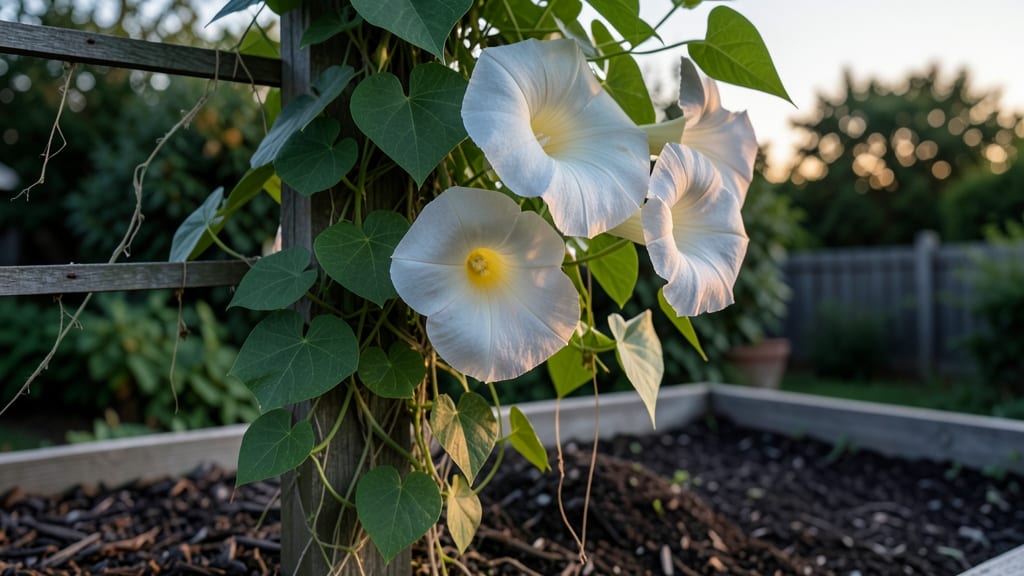
Moonflower vines will grow between 10 and 25 feet tall, depending on variety, support, and growing conditions—so your trellis better be sturdy!
Imagine waking up to fragrant, moonlit blooms cascading down your trellis—but how tall can moonflower vines actually climb? The answer isn’t just about space; it’s about the right growing conditions, pruning techniques, and even your hardiness zone.
Without proper support, these fast-growing vines can sprawl uncontrollably, while the right trellis or fence can push them toward their maximum 25-foot potential. In USDA Zone 6a, where spring planting begins in April, you’ll see dramatic growth by July—if you give them what they need.
Here’s what you’ll discover: how to choose the right trellis, when to prune for height, and the simple care routine that keeps your moonflower reaching for the sky—without taking over your garden.


Moonflower vine height by variety: from ground huggers to 30-Foot giants
Moonflowers (Ipomoea alba) are legendary for their nocturnal blooms and rapid vertical growth, but their mature height varies dramatically by variety. Some stay compact at 8-10 feet, while others become 30-foot giants—transforming your garden into a moonlit canopy.
The key lies in selecting the right cultivar for your space and climate, as well as providing proper trellis support and seasonal care.
In USDA Zones 9-11, tropical varieties like Ipomoea alba 'Moonlight' can reach 25-30 feet with ideal conditions, while dwarf varieties like 'Baby Moon' top out at 8-10 feet. Even in cooler zones (6-8), with proper winter protection, standard climbers like 'White Dawn' hit 15-20 feet.
Your local climate and soil fertility play a surprisingly large role—moist, well-draining soil with full sun exposure can push vines 30% taller than average.
🌱 Did You Know? Moonflowers grow up to 6 inches per day under optimal conditions, making them one of the fastest-climbing annual vines. Their twining habit means they’ll latch onto any sturdy support, but weak trellises can snap under their weight.
If you're in Zones 6-8, focus on varieties like 'White Dawn' or 'Ghost Moon'—they thrive with seasonal pruning to encourage bushier growth.
In tropical zones (9-11), 'Moonlight' and 'Alba Tropical' will dominate your space, but you’ll need reinforced trellises (like metal or wooden lattice) to support their weight. A 3-inch diameter trellis pole is the minimum for 20-foot vines.
Soil composition matters just as much as variety. Sandy loam with compost amendments promotes faster growth, while clay-heavy soil can stunt vines to half their potential. Test your soil’s nitrogen levels—too much causes leafy growth at the expense of height.
Aim for a balanced 5-10-10 fertilizer applied every 4-6 weeks during the growing season to fuel vertical expansion.
Pruning plays a crucial role in height control. Pinch back new growth by one-third when vines reach 3-4 feet to encourage stronger lateral branches. This doesn’t just make them bushier—it boosts flower production by redirecting energy upward.
In cooler climates, stop pruning by mid-August to let vines harden off for winter.
💡 Pro Tip: For maximum height, train vines along a south-facing trellis to capture morning sunlight, which fuels rapid growth. Avoid north-facing supports—they’ll slow vine development by 20-30%.
In container gardens, dwarf varieties like 'Baby Moon' can still reach 10 feet if given a 5-gallon pot and daily watering during dry spells.
Regional climate also dictates growth patterns. In humid southern climates, moonflowers grow aggressively but may need fungicide treatments to prevent powdery mildew, which weakens vines. In drier western zones, drip irrigation keeps roots consistently moist, preventing growth stunts from drought stress.
Always mulch heavily (3-4 inches) to retain soil moisture and regulate temperature.
Finally, don’t overlook the harvest impact on height. If you’re growing moonflowers for cut flowers, harvesting 2-3 blooms per vine weekly can reduce mature height by 10-15%.
For maximum vertical growth, let flowers fully open and fade naturally—this signals the vine to prioritize stem elongation over reproduction.
With the right variety, support, and care, your moonflower can become a dramatic vertical statement in your garden—whether it’s a delicate 8-foot cascade or a soaring 30-foot masterpiece. Start small, observe growth patterns, and adjust your approach as the season progresses. 🌙
5 Proven techniques to encourage maximum moonflower height
Moonflowers (Ipomoea alba) are natural climbers that can reach 20-25 feet with the right care—but most gardeners never see their full potential. The key lies in support systems, nutrient timing, and pruning precision.
Let’s dive into my top 5 techniques to help your moonflower vines soar like never before.
First, trellis selection makes all the difference. A 10-foot tall trellis with horizontal crossbars (every 2-3 feet) gives vines something to grip and climb. I recommend metal or wooden lattice for durability—avoid flimsy plastic that bends under weight.
Plant seeds 6 inches from the trellis to encourage upward growth from day one.
🌱 5 Proven Techniques for Maximum Moonflower Height
- 🪴 Install a 10-ft trellis with crossbars every 2-3 feet for grip
- 🌿 Prune aggressively in early spring to redirect energy upward
- 💧 Deep-water weekly during peak growth (June-August)
- 🌱 Feed with compost tea every 4 weeks for organic nutrient boost
- ☀️ Ensure 6+ hours sun—partial shade stunts vertical growth
Pruning is where many gardeners go wrong. Early-season pruning (March-April) forces the plant to focus on height rather than foliage. Cut back one-third of the vine just above a leaf node—this triggers lateral branching and stronger stems. Avoid pruning after mid-July, as new growth won’t harden before frost.
Soil amendments are often overlooked but critical. Moonflowers thrive in well-draining, nitrogen-rich soil. Mix in 3 inches of compost at planting and top-dress with aged manure in May.
For a nutrient boost, I use compost tea every 4 weeks—it’s organic, budget-friendly, and packed with microbes that improve root uptake.
Watering strategy directly impacts height. Deep soaking (1-2 inches per week) encourages deep root growth, while shallow watering leads to weak, leggy vines. Water in the evening to reduce evaporation and fungal risks. During peak summer heat, increase frequency to every 3-4 days—wilting vines can’t climb effectively.
Finally, seasonal adjustments keep your moonflower on track. In spring, protect young vines from late frosts with row covers. By summer, ensure the trellis is staked securely—heavy blooms can snap weak supports.
In fall, harvest seeds from dried pods to preserve your variety for next year.
With these techniques, my 20-foot moonflower now rivals my neighbor’s bamboo fence—and the fragrant nighttime blooms are worth every effort! Start small, stay consistent, and watch your vine reach new heights. 🌙